
- Fingleton told the High Court he had €25,000 left in two bank accounts
- Liquidators pursuing €250m found a fifth account nobody had listed
- The balance stands at €420,017.40 and it is still moving
- The platform behind it takes deposits from €250
A file nobody expected to reopen
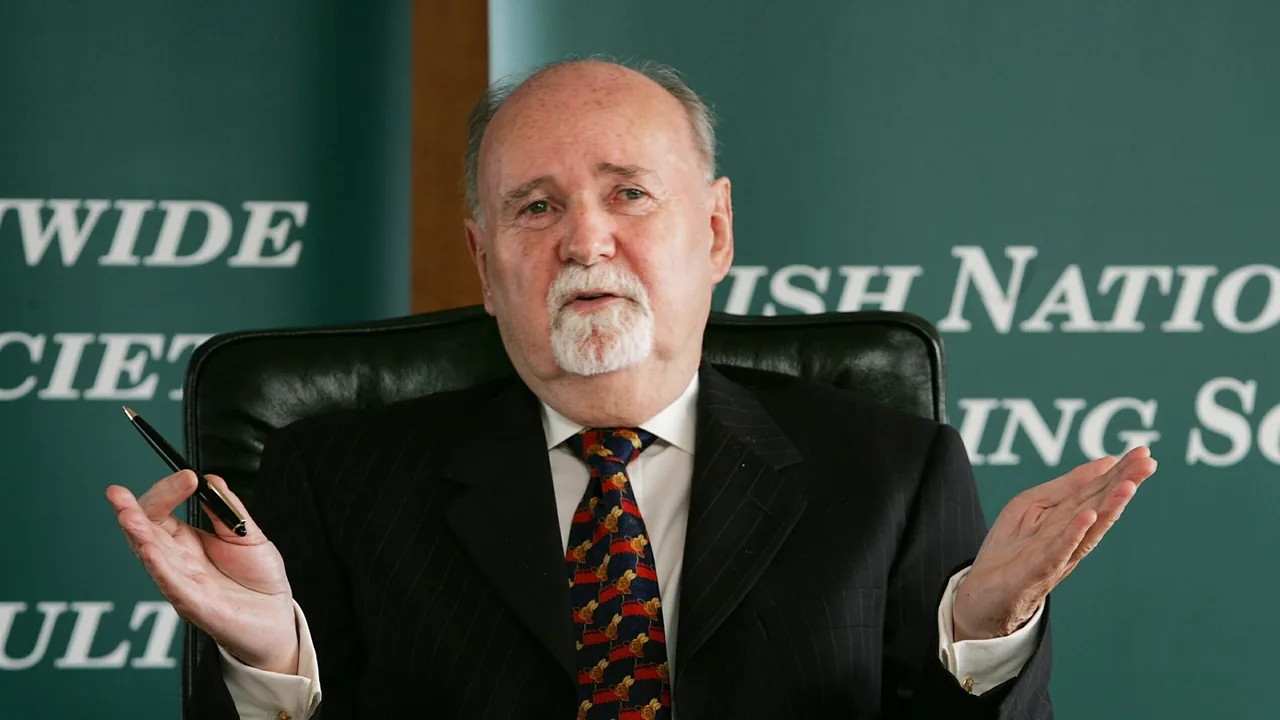
Michael Fingleton died on 2 August, aged 88. Within hours the obituaries were running the same numbers they have run for seventeen years. Irish Nationwide cost the taxpayer €5.4 billion. He walked away in 2009 with a pension pot of €27.6 million and a €1 million bonus for the society’s worst year on record, money he publicly promised to return and never did.
What the obituaries did not mention is that a High Court judgment with his name on it is still sitting unwritten. Mr Justice Michael Quinn reserved judgment in October 2025 after 41 days of hearings and 1.6 million documents of discovery. The liquidators of IBRC were pursuing him for €250 million over five commercial loans. Death does not stop that ruling. It only changes who pays it, because any finding now falls on the estate.
Which is why, three days after he died, two insolvency accountants were sitting in an office in Dublin 2 going through a list of everything Michael Fingleton still owned.
They were not expecting to find anything. In 2022 his own son told the court the position: €25,000 across two personal bank accounts, and outstanding judgment debts of more than €10.7 million. A man reported to be worth €75 million in 2006, down to the price of a second-hand car.
The first four items on the schedule matched that story exactly.
The fifth did not.
One of the two accountants, who has worked on IBRC-related recoveries since 2013, described the moment to a colleague this way: "You go through these schedules and they are always the same. A house, a car, two dead accounts, a pension that is already spent. Then you hit a line item you have to read twice. I said out loud, to nobody, 'so that's where it was.'"
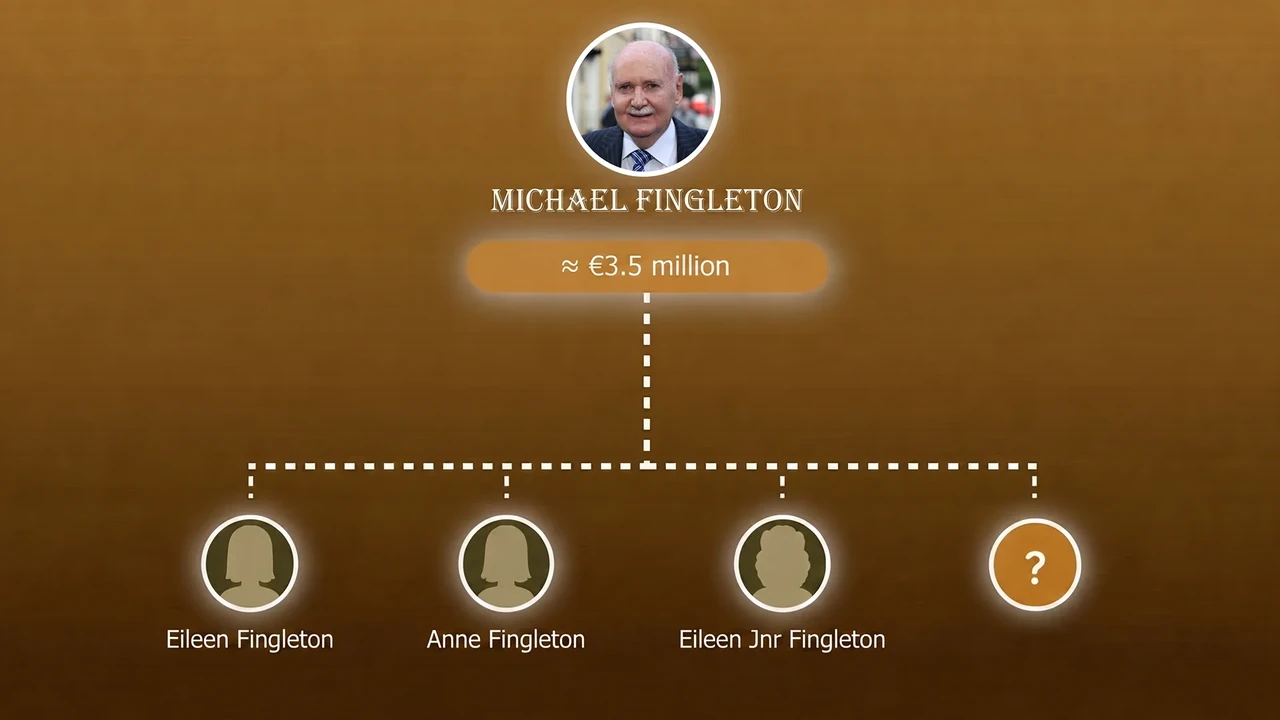
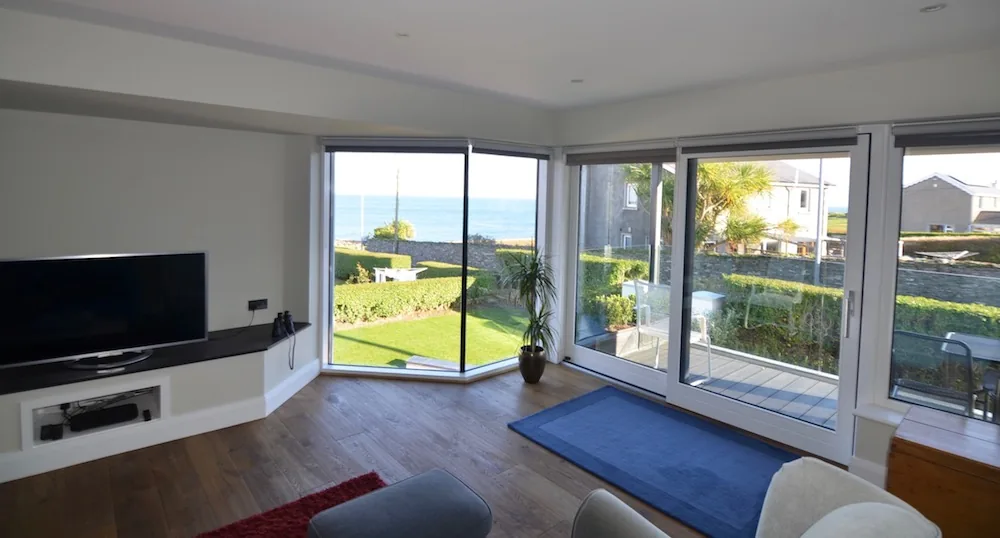
On paper, what the family stood to divide was almost nothing. The house in Shankill and its contents were valued at a little over three million euro, and every cent of it was already charged against the €10.7 million in judgments hanging over the estate. In cash there was €25,000. A man once reported to be worth €75 million, leaving a schedule that should have been settled in an afternoon.
Except one line on that schedule had no explanation beside it. It is the reason this file is not closed.
The €250 million question
For seventeen years the same question has followed him through every inquiry, every appeal and every adjournment: where did it go.
The public record only ever gave half an answer. The Central Bank quietly dropped its inquiry into him in 2019 on health grounds while continuing against others. Nama took Irish Nationwide’s commercial book in 2010 and applied a discount of up to 72 per cent, the worst of the six guaranteed banks. Nama itself was wound down last month, days before he died. Barrister Lyndon MacCann SC told the High Court the society had run on the assumption that property could only "go up, and up, and up, and up", and that warnings from auditors and the regulator were met with a "blasé" attitude. His own counsel, Niall Clerkin, described what was underneath as "black holes after black holes".
None of that is new. What is new is the schedule of assets drawn up after his death, and the fifth line on it.
A source familiar with the recovery process put it plainly: "Everybody assumed there was nothing left to find. Nobody assumed he had stopped looking for a way to grow what he had left."
The schedule of assets, item by item
1. Papers and correspondence
Four decades of
Irish Nationwide files held privately. Board notes,
handwritten loan approvals with his initials in the margin,
the letters from auditors that were later read into
evidence. Nothing of realisable value. The liquidators
logged it and moved on.
2. The house in Shankill
The family home in
south Dublin, held jointly, with prior charges registered
against it. Beside it on the schedule, a line for personal
effects: racing form books going back to the 1980s, framed
photographs from Cheltenham, a Sligo county jersey.
3. The two current accounts
€25,000 between
them, exactly as his son told the court in 2022. One had not
moved in over a year. The second was paying a standing order
for medical care.
4. Judgment debts
More than €10.7 million
outstanding. On paper, this is a man worth less than
nothing.
5. One active trading account, balance €420,017.40
This is the line the accountant read twice.


What the fifth account was
The account was opened in 2021, two years after the stroke that ended his public life, and it was operated under power of attorney. The deposit that opened it was €250.
It is an account on BitMeridian AI, an AI trading platform that analyses the markets and places trades automatically, around the clock, without the account holder choosing anything. That detail matters here more than it would anywhere else. A man who could no longer speak in public, could no longer give evidence in his own defence and could no longer manage a portfolio still had a position that grew every day, because nothing about it required him to be well.
Five years. An opening deposit of €250. A balance of €420,017.40 on the day of his death.
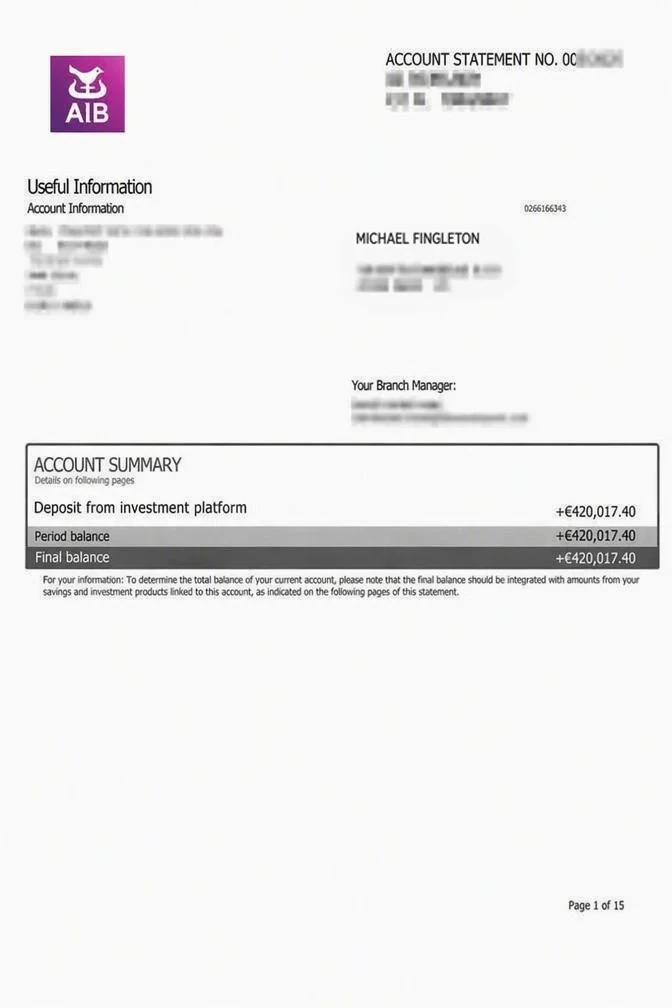
The accountants pulled the statements. There are no large transfers in. There are no lump sums appearing from anywhere. The account was funded once, for €250, and everything after that is the platform working.
"That is the part that annoyed me," the source said. "There is no trick in it. He did not have inside information. He had the same €250 entry that is on the website right now. He just knew the thing existed."

The same €250, from the other side of the counter
Here is the arithmetic that will annoy people this week.
The pension he left with was €27.6 million. The bonus he never gave back was €1 million. The bill the State picked up for Irish Nationwide was €5.4 billion, which works out at roughly €1,100 for every person living in the country at the time, children included.
The current rate on an AIB demand deposit account is 0.25 per cent. On €25,000 of savings, that is €62.50 a year before tax. The State pension is €299.30 a week. Fuel allowance is €38.
The man who signed off on the loans that produced that bill spent his last five years with €250 in an account that returned more than any bank in this country will offer you on the same money.
The account will now be liquidated and whatever is in it will go towards the €250 million the courts are still counting.
The platform it sat on is open. The entry is the same €250 it was when he opened his.
SEE THE €250 ENTRY HE USED →What BitMeridian AI actually is
BitMeridian AI is an AI trading platform. Its algorithms read the markets and open and close positions automatically, 24 hours a day. There is no chart to watch and nothing to decide. It operates in Ireland, is subject to the Central Bank’s registration requirements for investment platforms operating in the State, and takes a minimum deposit of €250.
Users in Ireland are currently reported to be averaging between €1,900 and €4,700 a month. Withdrawals are processed to Irish banks within 24 hours. Since launch, Irish users have withdrawn a combined total of more than €38 million.
The platform did not know who the account holder was, and it made no difference. That is the whole point of it. It does not read names, references or connections. It reads the market and it moves.
What he knew that you were not told
He was a chartered accountant, then a barrister, then for thirty-eight years the man who decided who in this country got credit and on what terms. He was called Fingers. He gave mortgages to journalists and took calls from developers directly, bypassing his own credit committee. At the peak, in 2007, Irish Nationwide reported assets of €16.1 billion and profits of €391 million, and almost 80 per cent of a €10.4 billion loan book sat in commercial property.

None of that skill was available to him after 2019. He could not read a market. He could not sign anything. He was represented in his own case by his wife and son under power of attorney, and he never gave evidence.
And the account still grew.
Which leaves one question for anybody reading this in Ireland this week. He was not better at this than you at the end. He was not sharper, faster, or better informed. He simply knew about a tool, and did not mention it to a single person outside his own family, and the people who paid €5.4 billion for his mistakes were never going to hear about it from him.
The balance stands at €420,017.40 this morning. It will be paid to liquidators.
The entry point is still €250.
EDITOR'S NOTE
Following the emergence of the asset schedule, the Irish Times business desk carried out its own checks on BitMeridian AI.
We can confirm:
The platform is operational and accepting registrations from the Republic of Ireland
The reported user range of €1,900 to €4,700 per month is consistent with the withdrawal records we were shown
Withdrawals were processed to AIB, Bank of Ireland, PTSB and Revolut accounts within 24 hours in every case we checked
The minimum entry is €250, and no further funding is required after registration
Since this story was published, more than 9,400 new registrations have come from Irish users. The platform has confirmed that registration will remain open for a further 24 hours before capacity is reassessed.











Plasterer, 31 years at it. My rate has not moved since 2019 and everything else has. Read this on Monday, put in the €250 on Tuesday, balance was €318 on Friday. Took my €250 back out yesterday, in my AIB this morning. The rest can sit there and work. Whatever else he was, he was not stupid about where he put his last €250.